Facebook Pinterest Instagram Bloglovin' Teachers Pay Teachers Image Map
Showing posts with label Assessment Tips & Tricks. Show all posts

Organizing Assessments and Evidence of Student Growth With Portfolios


Creating a strong student portfolio is an essential component of showing student growth and evidence of learning progress. The following is a collection of tips for creating a student portfolio that can be used first as a tool for parent teacher conferences, and then as a learning memory book at the end of the school year.

Setting Up Your Portfolios


Using legal-sized hanging file folders is the first step to creating an organized portfolio system. These slightly-larger file folders are perfect for filing special “Wall Worthy” projects that are often larger than 8.5”x11”. After you add name tabs to each hanging folder, organize them in alphabetical order by first or last name. 

Next, add two legal-sized manila file folders to each student’s hanging file. One folder will be designated for portfolio items such as projects, writing pieces, reflections, and important assessments. 

The second folder will be designated for forms such as confidential assessment data, parent surveys, student goal sheets, copies of IEP, SST, or 504 forms, and other student information sheets for teacher use. 

Preparing Portfolios for Parent Teacher Conferences


In the months leading up to parent teacher conferences, begin to take notes on student goals, strengths, and areas of need. You can type these notes into a form divided into two sections: Way To Go and Ways To Grow. Organizing information in this way quickly shows parents a few things going well for their young learner (in the Way To Go category) and areas that need development (in the Ways To Grow category). 

Next, collect evidence that can be woven into your conversations with parents at conferences. Providing them with visual evidence to support your commentary about their child’s progress makes these conversations more meaningful and easy to digest. 


Transforming Portfolios Into Learning Memory Books


Before your parent-teacher conference ends, decide which portfolio items you will send home with parents and which items you will keep until the end of year. 

Keeping all writing final drafts and art projects on hand and in chronological order is highly recommended. This allows you to easily host a learning celebration during which students can read through their best writing pieces, look back on all their artistic creations, reflect on their growth, and make plans for future learning. You are sure to feel a tingle in your teacher heart when the classroom fills with the sounds of flipping pages and tiny giggles as students look back on how far they’ve come since the first day of school. 

Everything Is Ready For You


This easy-to-implement portfolio system will keep you organized for conference season and provide you with a physical culmination of student learning at the end of the school year. If you are ready to bring these ideas to life in your own classroom, visit my Teachers Pay Teachers store to grab your own Editable Student Portfolio Toolkit.

Assessment with The Learning Chambers


One thing that I do in my classroom is to informally assess my students throughout the week.  It really helps me reflect and refine my teaching.  I love teaching in small groups and I informally assess my students to help guide my instruction.  It lets me know who needs reteaching and who is ready for enrichment.  Here are a few ways that informally assess my students every week.

Informal Reading Assessments 
I am constantly assessing my reading small groups to help guide my instruction.  I love using reading passages to have my students respond to their reading.  We read them closely and then I use comprehension questions to informally assess my students.  I then use the data and my observations to plan for the next day's instruction. 


My kids really enjoyed these spiders informational texts.  You can grab my Tarantula informational text HERE for FREE and try them out with your students.  The loved them so much and they had no idea that I was assessing their reading responses.


Informal Math Assessments
I also use informal math assessments to guide my math small groups.  I love guided math and also math enrichment.  This past couple of weeks we've been learning about angles, coordinates, and negative numbers.

I decided to use a STEM challenge and I also was able to use it to informally assess my students.


It was a great way for me to see who had mastered the concept of angles and also who needed to be retaught in a small group.


Want to hear more about my ozobot challenge?  You can check out my blog post HERE.

Assessments { with Stephany from Primary Possibilities }


I give quick and simple assessments to my students before, during, and after instruction.  The format and types of questions are the same that my data is consistent.  They numbers within the problems are different.


You can grab up the Common Core Assessments above by clicking on these links:  


Once I have graded the assessments, I use these tracking forms to keep track of mastery.  This helps me keep track of who needs retaught, how many times a student needs a standards retaught before mastery and who can move on to the next skill.

You can grab up these Common Core First Grade Math tracking sheets by clicking on the image below.  Be sure to follow my store for more freebies and updates while you are over there!


Assessment Tips & Tricks {with The Sunny Side of Second Grade}


Hey y'all! Welcome back for our last post on Assessment Tips & Tricks. Today I have for you a very cool website I have been using to help with assessments. My students are still getting used to it, but I have high hopes! :)

As you probably know, I work at a Magnet School for Technology and Innovation. We are always looking for ways to incorporate more technology, but do so sensibly. As a PLC, common assessments are essential to determine standards mastery. Our team found a lovely pack on TPT that has been helping us bring common assessments to life in our classrooms and across the campus. With the website I am about to introduce to you, you can literally upload any picture and make it fillable. Say whaaaat?! Oh wait...there is more!!

Not only can you do that, but if you wanted to, you could type up your own assessment. The possibilities really are endless. I am talking written comprehension, reading response, math questions, word problems, you name it, you can make it. And what's the best part? All the answers come through to your screen LIVE! That's right!! If you have your computer screen up, you can see students' answers as they input them. You wanna talk about reteaching glory?! Can you hear the angels singing already?

Okay...now let's unveil this baby! May I introduce you to GoFormative

Have I convinced you to sign up yet? Look how colorful!!


Thank you Jen Jones for this amazing product. Character change is really a beast for my little sweeties, but that is a whole other post.
I hope this saves you time and paper money as much as it has me. I know my students are totally loving using this website. They have become very self reflective when seeing their scores immediately. In addition, I am able to sit down and conference with them immediately, if time allows, in order to reinforce some skills they may be having difficulties grasping.


Assessment Games - Lauren from Mrs. Thompson's Treasures


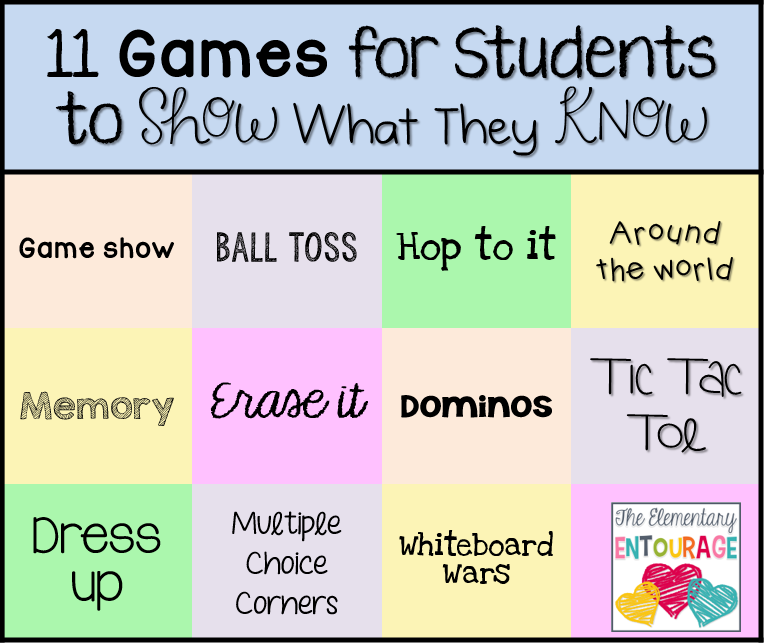
We all know that some assessments are not optional. Our little kiddos must sit in their desks and show what they know with a pencil and paper. But, many times, in our daily learning, we can assess our students in so many other creative ways than tests! I'd like to share with you 11 fun games that you can play with your students that will let them show what they know!


1. Game show: This is always a kid favorite! I make up questions about a unit (this works well with science and social studies) and then set up the white board like this with different point amounts. You can also break the questions up into different categories, but I usually just use different colors.

 
Split the class into 2 teams and have them take turns picking a question. If they get it right, their team gets that amount of points. If they are wrong, I give the other team a chance to "steal" and earn half the points. You can make up the rules however you want though!
 

2. Ball Toss: Split the class into two teams. The students take turns answering questions. If they get it correct, they earn a point for their team. They also have a chance to earn an extra point by shooting a ball into a basket (trash can, bucket, etc.) You can just have one basket to earn one point, or have several in a row worth different amounts of points.

3. Hop to it: This game works well for small groups or individual students. I have used it for sight words, mental math problems, and vocabulary words. Write the answers on pieces of paper and scatter them face up around a space. Then as you read out a question/word/definition,  the student will hop to the answer and put their toes on it.

4. Erase it: For this game, I draw circles on the board and write in them sight words or math problems. Then, I call out the word or the answer and have a student erase the correct circle. This can be done as a contest between two students to see who can find and erase it the fastest, or students can just take turns for fun.


5. Around the World: This a classic game that I remember playing when I was in school! Start with 2 students who sit next to each other. They will both listen to a question and the first one to answer correctly moves on, and the other student sits back down. The winner moves to the next student and competes against them with another question. The winner moves on again. The idea is that the first person who goes all the way around to their original seat is the winner.

6. Memory: Create a memory game by using index cards cut in half. On half of them, write a question, sight word, rhyming word, math question, etc. Then on the other half of the cards, write the answers (could be a matching sight word, picture, rhyming word, etc.) Have students work in pairs to play the game. Turn all the cards face down, then they take turns picking two cards to see if they match. If they do, the student keeps the cards, if they don't, the cards are put back face down.
 
7. Dominos: Students love this game to practice addition or multiplication, and it can be played with 2 or more players. Turn a set of dominos face down and have each player turn one over. Then everyone adds (or multiplies) the sides of their domino together. The player with the highest number keeps all the dominos that round. Keep going until all the dominos have been collected. For more of a challenging game, students can draw two dominos and add up all the sides, or multiply the total number on each domino together.
 
 
8. Tic Tac Toe: This can be a game for any subject! Simply draw a big tic tac toe on the board, and divide the class into two teams. Take turns asking them questions, and when they give a correct answer, they get a turn to draw their 'x' or 'o' on the board.
 
9. Dress up: This game will have your students laughing 'til it hurts! Gather a collection of fun dress up items (hats, sunglasses, scarves, jackets, anything silly!) Go around the room and have students answer a question. If they miss it, they have to pick something from the dress up items and wear it until the game is over. If they get it right, they pick something for the teacher to wear! Keep going until all the items are being worn, then you can start over!
 
10. Multiple Choice Corners: This is a game to get your students moving! Put up signs in the corner of the room with 'A', 'B', 'C', and 'D.' Then give a question with multiple choice answers and have students walk to the corner that is the right answer.
 
11. Whiteboard Wars: This is a great way to assess all your students at once. Have students use individual whiteboards (or just a piece of paper in a plastic sheet protector) and have them write down answers to questions. You can even make it a competition to see who gets the right answer quickest and holds it up.

 
I hope these games give you some fun ideas to use with your students as you creatively assess what your students know!


Assessment Tips & Tricks { with Mrs. D's Corner }

Happy Monday everyone! Only a few more of these left until summer... Monday's that is!

It's crazy to think that this school year is almost over because it feels like it just started. It feels like just a few weeks ago I was taking initial data points on what my little friends know and making goals for where I wanted them to be at the end of the year.

To be honest, I kind of just threw a bunch of resources together to assess them at the beginning of the year since it was my first year as a life skills teacher. I feel like I've grown so much and learned so much from my special friends over the last couple of months, that I feel like I'm finally on top of my game. And what a great feeling it is when you find the perfect resource to help you out. Enter assessment rings!
The amazing Erin from Creating & Teaching created these sets of assessment rings and as soon as I saw them, I had to have them! I printed them out on cardstock (there are currently 5 sets available in her TpT shop at the time of this post), laminated and cut them out, then punched a hole and added the book rings. It did take me a day or two or three to get them all set up, but all completely worth it.
I added command hooks to the wall behind my kidney bean table, which is where we spend most of our time. It's so convenient to be able to grab a ring set and have assessment at my fingertips!

So what do they look like and what sets do I have? Erin created a set for colors, shapes, numbers, the alphabet, and common objects. Within each set, there are different "levels" of mastery that is perfect for differentiating the assessment for your friends.
With the common objects assessment rings, my students are working on identifying objects from sets of 1-3 objects, as well as identifying the function of specific objects. It's a great way to assess what they know, without my little friends feeling like they're being tested (and to me, that's key!).
 Snapshot of one of my friends working on identifying colors from a field of 3. 
Besides the fact that my assessment has gotten SO much easier to collect data, I love the fact that my kids can fling the rings around, shuffle them up, drop them, and pretty much do anything to them and they all stay together! It's genius!

Okay, so you've made it through this entire blog post with me sharing how amazing these assessment rings are... and you really thought that I wasn't teaming up with Erin from Creating & Teaching to give away a BUNDLE of these babies?!

a Rafflecopter giveaway
 

Assessment Tips & Tricks {with The Primary Gal!}


Testing!  We all dread it.  We all stress about it.  But in the end, we can't avoid it. And who doesn't need a tip to help our students cope with the stress?  My tip today is a random thought I had during our first round of ISTEP testing.  In Indiana, we take two high stakes assessments.  The first is Applied Skills and is a paper/pencil test and is taken in February.  The second is the bulk of the test and is taken during the end of April on computers.  


I'm sure you all are in the same boat and I am.  My walls are covered with posters and anchor charts that we use throughout the year.  However, during testing we have to cover them up. 


So, I did my duty and covered my posters with random paper a few days before testing was scheduled to begin.  And then, I had an idea!


I LOVE motivational quotes.  I have them all over my room and my kids seem to enjoy them, especially when I get a new one!  I also know that I tend to get a little winded when encouraging them right before taking our test.  So I got out my Silhouette Cameo and got to work!  

On the day of testing, they came in to a few motivating quotes to help them get in the right frame of mind for testing.  I used these quotes in the morning as I encouraged them to do their best and remember that they have worked all year to be ready for this.  

I had three sections that I "covered and quoted".  My quotes were:

"Keep Calm and Show Your Work"
"You may be disappointed if you fail, but you'll be doomed if you don't try." -Beverly Sills
"Trust Yourself.  You know more than you think you do."-Benjamin Spock

What do you do to bring a little motivation to your kids at testing time?  :)


Assessment Tips & Tricks {Keri from Enchanted Kinder Garden}


Just the word assessment makes me shudder. I don't know about you, but I absolutely DISLIKE report card time. Luckily, I don't have to do progress reports so I only have to deal with HUGE assessments and putting in grades 4 times a year.

As you know, I teach kindergarten. We have a standards based report, for K, in my county. Once they are printed off, they're usually about 3 pages long. YES! A report card that is more than ONE page. Last year, we had 17 to 20 page tests for EVERY SINGLE child each quarter. For an entire week, we shut down ALL teaching and pretty much had to assess the entire week. Part of this was due to the fact that we didn't get assessments until maybe a week or two before they were to go into the computer. We had to individually assess every child. Think about how long that takes?

Personally, I hated it.

I didn't understand why we had such long tests. There had to be an easier way. HAD TO BE! Then, last summer I went to Vegas. My first few sessions ALL mentioned ESGI. I had heard of it before. Our principal even asked us about it in the middle of the year, but we didn't take the time to actually look at it. One girl did and she didn't like it. So that was that.

I started a trial that night. I played around with it. I read some reviews on it. I was in love. We got a new principal and she asked us about it. I wanted it. I needed it. There is so much that you can do with ESGI on a day-to-day and weekly basis that could save me SO much precious time. I let her know that there had to be something that we were missing about it and I wanted it.

So. We got it. And I love it. Here's why.


I no longer have to waste hundreds of copies every single quarter on assessments. Everything is saved online.


The assessment are so easy that you can make them YOURSELF. Just a few minutes of your time and you're done. If your county has them made, just link up to your county. It's that simple. You can always search for the standard that you need.

Here's how I assess my kids. I have my laptop/iPad open to ESGI. I give the child an iPad. I have a dummy account with my name on it. I allow everyone to test under that account when we start from scratch. It saves so much time. They click no for each answer - I tell them to click N to move on to the next question. I click either Y or N depending on the correct answer. They never see whether they got it wrong or not and they don't have to stress or watch we mark something out. I love that they don't know.


I love a good report. We use these to turn in during RTI meetings, parents, conferences, and anything else where you need to show data for a child. Everything is already made for you. All you have to do is assess the children.

Every report card, I print out this parent report. It has the child's name at the top. I attach this to the report card. It lets them know what was missed exactly on each standard. Some are a little harder to understand than most, so I include an explanation at the beginning of the year. Standards based report cards are difficult for many parents to read, but they are so EXACT. I'm happy it doesn't just say MATH with a G, S, or N next to it. We are able to say exactly what they are excelling in.
 After assessing students, the assessment stays for the next quarter with anything that was missed. For example, if quarter 1 under letters we assessed 10 letters and a child missed 3 - those 3 letters will show up in quarter 2 until they are mastered. This allows me to quickly see what the child STILL needs to work on. It also helps me not to forget something even though we may have already covered it.
 LOVE THIS OPTION! I love that they give these graphs. I am able to see what percentage of my kids mastered what on these assessments. Sight words is a BIG one. It's so hard to keep up with what children know what words. I can easily look at each tab at the bottom and it give me a detailed list of how many students mastered each. And the best part, I didn't have to type any of this information into anything. Such a time saver. I can use all of this data to plan for the weeks ahead.


I can also use this to plan.


Parents can use these flash cards to practice with skills that have not been mastered at home. This is great for identifying numbers, letters, sounds, and sight words. You can quickly print off what they need to work on and send it home. Parents can cut the cards at home, saving you time.


In a few weeks, we will begin assessing the current pre-k students. Also during our pre-registration, we will assess those students. This helps us to place students into classrooms for the next year. This information will also be saved into ESGI for the next school year. Students can be moved over from classroom to classroom. I will already know in August that "Kennedy" know all of her numbers up to 15 and that she doesn't know any of her sounds. This is going to be beneficial each and every year because we usually know NOTHING about our students when they come in. I will reassess all of my students at the beginning of the year to see what they all know at that point, but for those that have already been assessed - I won't have to test them on that much.

They also JUST, as in just I mean this week, rolled out where you can keep track of previous testing. When you open a test, it will ask if you want to test only the incorrect responses or retest everything. I love that they are improving as they see a need.

EASY right? If you teach kindergarten or have a standards based report card, I seriously encourage you to look into ESGI testing. There is SO many great options for you. I'm sad it didn't come into my life sooner. I save so much time every year and am able to continue teaching and not interrupt our crazy schedule as much as I used to. I hope these tips through ESGI can help at least ONE of you.
If you want to save $40, use promo code: B7105 or click below.


Pre-Kindergarten - 1st Grade Classroom Tools