Facebook Pinterest Instagram Bloglovin' Teachers Pay Teachers Image Map
Showing posts with label movements. Show all posts

Incorporating Purposeful Movement into Science Content Instruction

Although there are many opportunities for students in my STEM class to participate in hands-on activities or move around the room as they collaborate, there are also days when the lesson is pretty teacher centered. I have had to be creative when I plan for these lessons so that I can get students up and moving and refocused.
I think most people would agree that when we exercise, blood flow throughout the body increases. But did you ever stop to think that the blood also flows more to our brains as a result of physical activity? With this increase of blood flow to the brain comes more oxygen which enables our brains to perform better.

Shift to the classroom setting where much of the day (especially in upper elementary and middle school classrooms) is spent sitting at a desk listening and/or taking notes. Why not find ways to incorporate movement into instructional activities in an effort to improve student comprehension and overall concentration?

Although there are many opportunities for students in my STEM class to participate in hands-on activities or move around the room as they collaborate, there are also days when the lesson is pretty teacher centered. I have had to be creative when I plan for these lessons so that I can get students up and moving and refocused.

One strategy I incorporate regularly is the Kagan strategy Mix-Pair-Share. In this class building structure, students "mix" around the room while I play music. When the music stops, they partner up with the person closest to them and share their ideas or answers to a question. I love how this gets my students thinking, moving, and talking to each other about topics that we have been learning about. It also ensures that each student has a chance to share their ideas. Everyone is engaged in the discussion instead of just a handful of students.
Although there are many opportunities for students in my STEM class to participate in hands-on activities or move around the room as they collaborate, there are also days when the lesson is pretty teacher centered. I have had to be creative when I plan for these lessons so that I can get students up and moving and refocused.
A second way I incorporate movement is through the use of hand signals or body movements as a way for checking for student understanding. If I have students respond to a multiple choice question, they may walk to a corner of the room designated as A, B, C, or D based on their answer. Sometimes I simply have them stand up to agree or choose a side of the room. During a review of examples of potential and kinetic energy, I posed several simple scenarios for students to classify. To show me their response, they stood up to represent potential energy (because they are higher above the ground and thus have more gravitational potential energy) and they waved their hands above their heads to represent kinetic energy (because going down the first hill of the roller coaster involves kinetic energy of motion). They got a chance to move AND show their understanding.
Although there are many opportunities for students in my STEM class to participate in hands-on activities or move around the room as they collaborate, there are also days when the lesson is pretty teacher centered. I have had to be creative when I plan for these lessons so that I can get students up and moving and refocused.
I also like to have students complete SCOOT "games" - basically another way to check for understanding - by placing various questions around the room for students to scoot to and answer on a sheet of paper. Rather than a basic independent worksheet that is completed in class, students answer similar questions while moving around the room. I've even had them make observations and identify the physical properties of matter while "scooting" around the room.
Although there are many opportunities for students in my STEM class to participate in hands-on activities or move around the room as they collaborate, there are also days when the lesson is pretty teacher centered. I have had to be creative when I plan for these lessons so that I can get students up and moving and refocused.

Finally, every teacher recognizes that students aren't able to focus on content learning every second of every day. Even as an adult, I find my mind wandering and my attention drifting during especially long meetings. Using physical activity breaks in the classroom helps students get ready to learn and remember information better.

I use the activities in this set of Brain Breaks for Bigger Kids to get my students up and moving. To refocus them. To encourage them to think in a different way. To reward them for good behavior. I will even leave the cards for a substitute teacher as "filler activities". (My students LOVE that if they complete the assignment given by the sub they can have a brain break at the end of class!)
Although there are many opportunities for students in my STEM class to participate in hands-on activities or move around the room as they collaborate, there are also days when the lesson is pretty teacher centered. I have had to be creative when I plan for these lessons so that I can get students up and moving and refocused.
 Although there are many opportunities for students in my STEM class to participate in hands-on activities or move around the room as they collaborate, there are also days when the lesson is pretty teacher centered. I have had to be creative when I plan for these lessons so that I can get students up and moving and refocused.
Some of the ideas are simple (or even common), but I find that by having a set of ready-to-go brain breaks on a ring I am more likely to flip through the cards and actually USE them on a daily basis. And that's the point, right?

What other ways do YOU find to incorporate movement into your lessons?

5 Ways to Get Your Students Moving


Incorporating more movement into your school day doesn't have to be difficult. Little changes can add up to make a big difference! Here are 5 easy ways to get your students moving and learning!

1) North, South, East, West - This is a fun game to play while reviewing any subject. All you need is 4 walls and some multiple choice questions. Tape a sign on each wall with the correct direction. Then read a question to your students, giving the multiple choice answers as N, S, E, or W (instead of A, B, C, or D) Students then move to the correct wall to show they know the answer to the question. 

2) Vocab Match Up - Students love this game to practice vocabulary words. Use index cards and write vocab words on half of the cards and the definitions on the other half. (You can also do this with math problems, putting a math problem on half the cards and the answers on the other half.) Mix them up and pass them out. Students then walk around the room comparing cards with each other until they can find their match. Gather the cards, mix them up, and play again!

3) Move it outside - With spring approaching, now it the perfect time to get students outside! Have students bring their journals outside to complete a writing assignment, or have them do an observation of something in nature. 


4) Sidewalk Chalk - Even older kids can have fun with sidewalk chalk! Work on math problems or spelling words outside on the sidewalk. Once I even had my class do a collaborative project where we drew a life size blue whale with chalk in the bus lane. 

5) Movement Jar - Write some quick exercises on slips of paper and put them in a jar. Examples could be 10 jumping jacks, hop on one foot for 30 seconds, touch your toes 5 times, etc. During times when you are already transitioning during the day say, "Time for the movement jar!" Have a student pick from the jar and read the movement. It takes only an extra minute, but it can really help add movement throughout the day!


Focused Movements = Focused Learning (Sassy, Savvy, Simple Teaching)

The topic of physical movement embedded in instructional settings is HUGE! The research is strong and it expands in a variety of ways. As adults, we all know we don't learn when we are sitting in lectures. So why in the world would we ever assume a young human could?!?! 

Currently as a 5th Grade ELA teacher in tight quarters with 50+ large bodies, I was in search of some moving / life skills to implement in my classroom. Today, I'm going to share with you how I keep the students moving in our classroom.


Going into my journey I was looking for a way to allow my students to move their bodies in a healthy manner that included strategies of concentration, focus, decompressing and alignment. 

I found myself reading and researching online for solutions that would work in my classroom. I immediately started looking for more information on blood flow, oxygen flow, calorie burning, posture, body alignment, focus and concentration.

I began with a complete flexible seating classroom. The research of alternate seating all leads to increasing consistent positive body movements which then leads to inner body functions flowing constantly which allows alertness. 

I wrote a complete blog post of how I created a budget friendly classroom transformation on my blog and the reasons why flexible seating improves inner health through the positions of your body.

[click here or on any of the photos below for a direct link]


Then I began breathing and meditation exercises combined with yoga for our transitions between Reading and Writing. 

My classroom's daily agenda:
1) Daily Language/Grammar and Focus Board
2) Writing Block
3) Break- Breathing, Meditation, Yoga
4) Reading Block

The research of breathing, meditation and yoga in schools is completely spot on in my classroom. 

The yoga exercises allowed my students not only to move their bodies through stretches and poses, but it also helps align the child's spine. This is a huge benefit to me as a child's spine needs to be stretched into the proper position every so often after sitting in a position for a certain period of time. Yoga poses allow for proper blood and oxygen flow through your body as the poses change in a sequence. Yoga also helps to build core strength and muscle strength in the limbs.

The breathing and meditation exercises allow my students to center themselves as the day progresses. It's very important to me to teach my students life strategies that they can use beyond my classroom. This is a single time each day where my students are able to close their eyes and focus only on there own mental state. I have students with high anxiety and really bad nerves. Students need a strategy that allows them to step back, refocus and then return to a task. It helps students to be able to focus on their breath as a strategy and as an anchor to their inner-self. 

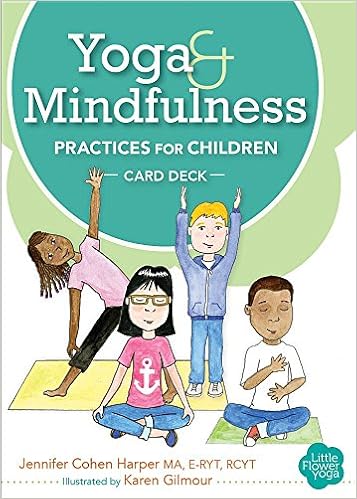
Here are some cards I use daily in my classroom. They allow teachers to read to the students as the meditation, breathing or yoga activity goes on. I simply play music through Pandora or Spotify. 

Click here to purchase these cards for your classroom or on the photo below -

Here as a small clip from my classroom, I sped the timing in it up a little bit...
Everything in the video comes from teaching students from these cards!


I hope this informational has helped you in a useful manner! There are a ton of different routes to go when implementing movements into your classroom! I hope you follow me along my journey by click below:-)