I love integrating the arts in my classroom. We do something with art each and every day, but there is one thing that sticks out in my mind!
We LOVE cooking in the classroom. There is so much students can learn from cooking. There is math involved, real life skills, and more! My two favorite recipes we do each year are pumpkin pie in a cup and main idea pudding.
The BEST cooking we do all year is main idea pudding! My students have trouble grasping the concept of main idea and detail, so we give the students a recipe without telling them what they are making. They follow the entire recipe and make the pudding in a cup. When they are done they have to figure out what the recipe title is or the "main idea". Then, we talk about if you missed details you would change the main idea. This is something that truly helped my students understand the difference between main idea and detail plus it was SO MUCH FUN! Read more about it here and grab it for FREE.
Pumpkin pie in a cup is great activity to do in the fall! The students have to read directions and make the pumpkin pie. Then, you can have them do a quick writing project on how to make the pumpkin pie! Check it out here!
Even teachers enjoy the pumpkin pie in a cup!
Showing posts with label reading freebie. Show all posts
Tricks & Treats from Enchanted Kinder Garden
It's finally fall and I love everything that October brings. With that in mind, my favorite thing to teach is pumpkins. I'm not sure why, but I love all of the exploring, the new learning, the investigations and everything that pumpkins bring to my classroom. It's always been one of my favorites and will continue to be.
My first must have book is Piggie Pie. I LOVE LOVE LOVE this book. In the story, a witch wants some piggie pie, but she doesn't have ONE ingredient. The story takes you through all of the craziness that the pigs do to stay hidden from the witch. I always tell my kids that I luckily found some pigs and we're going to make piggie pie. *insert everyone freaking out* We actually make pumpkin pie in a cup, but my kids don't know it. I crush and set everything up before we read the story. This way, they don't see any boxes that tell what it is they're really eating. It is hilarious to see them make such funny faces. We respond to the story with a what would they do if they were the pigs. It's always fun to allow the children to place themselves inside of the book and become that character. In this case, they were a group of pigs that did not want to become pie for the witch.
My second is Seed, Sprout, Pumpkin, Pie. If you're in need of a book that has some great pictures - this is one of them! It shows some very detailed pictures of the life cycle and things that can be made from pumpkins.
A few other fun books include I Like Pumpkins, The Biggest Pumpkin Ever, From Seed to Pumpkin, The Legend of Spookley The Square Pumpkin and Pumpkin Town. Pumpkin Town is a favorite for me to use to teach sequence. It's about some brothers that plant seeds and mistakenly throw them over into the next town. The seeds land EVERYWHERE and creates a town full of pumpkins.
I have a HUGE collection of fall/October themed books. The reason that I love October themes so much is because they're so much fun to teach and they're so easy to plan. I have a few different reading response sheets and learning sheets to help you get through the month of October. See it as my treat to you!
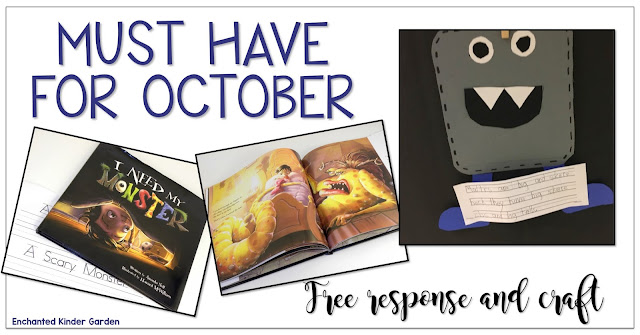
I absolutely love the story I Need my Monster! I got this book after October last year through Donor's Choose. It's about a boy who usually has a monster under his bed. Well, the monster goes on a little trip and the boy just HAS to have his monster back. It goes through various monsters and is a really neat and funny book to read.
We talked about what would make a scary monster and responded to the story and made an easy craft. The response sheet can be downloaded above. The monster craft can be downloaded here:
Sensation Science Integrated in your Reading Block! {with Sassy, Savvy, Simple Teaching}
Welcome to the Elementary Entourage! I'm Dianna from Sassy, Savvy, Simple Teaching here today to share about SCIENCE in your READING block!
YES! Informational studies integrated into your Reading block has so many benefits! Here are a few:
- High Interest
- Complex Text
- Content Vocabulary
- Academic Vocabulary
- High Levels of Comprehension through Oral and Written expression
- Research Opportunities
- Covers Informational Standards
- Covers Science Standards
- Can Implement Technology, Writing, Speaking and Listening Standards!
Another advantage to integrating Science into your Reading block is the ability to pair texts! Grab a fictional text that goes along with your Science topic. There is so many possibilities and you can cover so many standards each day by using this Instructional Approach.
You can implement Science in your Reading block through:
- Read-Aloud
- Shared Reading
- Interactive Reading
- Guided Reading
- Close Reading
- Cloze Reading
- Buddy Reading
- Independent Reading
My personal favorite way to implement Science into your Reading block is through Close Reading with small groups. I love this opportunity to engage students with high interest content at a high lexile range. I find students are more willing to attack the text using their strategies if they are interested. It especially helps me from an instructional stand point interact with students and use a variety of reading strategies and skills! I love to use a range of topics with subtopics I can focus on during blocks of time that also correlate with the Science topics covered in the grade level.
I use this time to revisit text frequently as I work through the standards with students as well as focus on word solving strategies, fluency, comprehension, phonics and more!
Below is an example of how I use Science Close Reads in my small group instruction:
{Click HERE or on the photos below for a direct link!}
Click HERE or below to try a FREE SAMPLE for yourself!
You can find a range of Science and Social Studies topics in my store that you can integrate in your Reading block by clicking HERE!
Making the Most of your Small Group Instruction {with PeppyZestyTeacherista}
Hey, Friends!
First off I know you're reading this thinking, 'who on EARTH has time for so many small groups'? I agree that is IS tough to manage small groups effectively every week. We do what we can and if we can't meet with everyone so many times a week, we're human, it's not like we're not working hard to try.
Before I even begin with how I run my small groups, I want to chat about the logistics of what everyone else is doing.
If I am going to be effective with the group that I am working with, I need to be able to actually work with them with minimal distractions. This means creating a self-sufficient classroom environment.
While I am with a group, the kids have a series of tasks that they have to get done by the end of the week. They must do everything on the left hand column and if they have time they can do the extras on the right. OR they can mix and match the left and right columns but must know that everything on the left column must be completed.
If you would like this template for FREE
Let's say that time gets away from me and I don't have time to gather my centers together (it happens we can't do all million tasks let's be real). If I have a series of tasks that the kids started but haven't completed, I type it up on a Powerpoint and the kids just complete down the line.
If you would like to get my entire reading bundle:
I hope this was a PeppyZesty idea for you!
On Track and On Target {with The Sunny Side of Second Grade}
Hey y'all! Welcome back for another installment of our series on tracking data and setting student goals. We are all constantly trying to aim for student independence and standards mastery. What better way to do that than to track individual student data and goals? We can teach all day long, but if we have no way of tracking student progress, then how do we know for sure what we taught really hit home?
One of the items I use in my class is something I created to be used with my R.E.A.D.I.N.G. and iR.E.A.D. literacy station management packs. Inside the individual packs, you are given several planning and data tracking sheets to use when you meet with your small groups. These are tracking sheets I keep in addition to the data tracking I use with my district level tracking through mClass. All of the pieces fit together in a nice little puzzle that helps me figure out just what a student needs to be successful.
This planning page will help you work with students in small groups and target standards and even interventions within the group. It really helps me identify individual students that need additional support. Stay on track with this planning page, and keep your students on target with the standards they need to keep them progressing.
After meeting with your little sweeties for a while, you will be able to monitor their progress using this progress monitoring sheet. Specify the concept/standard you are targeting at the top of the page. I would recommend involving your students in their progress monitoring, explaining to them the purpose and allowing them to color in their own graph. This helps students take ownership of their education and push harder to master their individual learning goals.
If you like these planning and tracking pages, you can snag them for free here: Planning Reading Stations FREEBIE or you can grab these and more in one of my full literacy management systems: READING Literacy Management System or iREAD Literacy Management System.
I hope this has helped you on your individual journey to help your students learn and grow!
Homework: The Great Debate!
Ah, the great debate...HOMEWORK! It's Kim here from For a Love of Teaching, and before I continue I must explain a little bit about myself. I'm no longer a classroom teacher. This past summer I accepted the position of Technology Facilitator at my school. However, I taught 3rd & 4th grade for 14 years where I assigned homework on a regular basis. So, I do feel that some homework is essential in establishing self-discipline and independent study skills in students.
Homework tends to be a love/hate relationship for teachers, parents, and students. Parents either hate homework and complain about it, or they love it and beg for more. In my school district, we have a homework policy that helps clarify general expectations for students, parents, and teachers. It explains the reasons teachers may assign homework. It gives "suggested" minimum amounts of time students should spend on homework, and it provides ways parents can support their child's learning environment at home.
When I taught in the classroom I always tried to follow the time chart. As a parent, I know how limited time at home in the afternoon can be.
I knew that assigning the right kind and right amount of homework was important. I knew that homework needed to be based on the application of concepts learned in the classroom. I also knew that it needed to be goal oriented with timely feedback provided for students.
When I taught 4th grade, I required nightly reading and students recorded their reading on a reading log that was checked daily. Students were also given a spiral review of weekly math (Math 4 Today) to complete that was given to students on Friday and due the next Friday. It was also essential that 4th grade students master multiplication facts 0-12 in order for them to be successful in math. For the first semester of school, students were required to practice memorizing multiplication facts at home. All three assignments we're goal oriented with reading and math goal charts were kept at student's desks, in their binders, and/or displayed in the classroom. Timely feedback was provided and rewards were given for successful completion at the end.
As a teacher, I strongly believe that the love for reading starts early. I ALWAYS required nightly reading at home even when I gave breaks with weekly math homework. I encouraged it over holidays and highly recommended it during the summer months when our students were not in school. I always sent home this visual as a reminder to parents about how important reading is at home. You can download it for FREE in my store!
I think the biggest issue with homework is that some teachers don't think about the objective of the homework assignment before giving it to students. I've seen this happen time and time again with my own children. I think, as teachers, we have to ask ourselves:
1) Is it meaningful?
2) Can it be completed independently?
3) Is it the right amount? How long will it take to complete?
4) Is it based on concepts learned in the classroom?
5) Is it manageable for the teacher and student?
How do you feel about homework? Do you give it? If so, how much? I'd love to hear your thoughts!
Subscribe to:
Posts (Atom)