Facebook Pinterest Instagram Bloglovin' Teachers Pay Teachers Image Map
Showing posts with label STEM. Show all posts

Student Led Learning in Upper Elementary

This is my first year teaching in upper elementary. One of the things that I have really worked on is implementing student-led learning in my classroom. It is definitely an area that I am constantly reflecting on because I definitely see a lot of growth from my students when they lead the learning. It also helps make learning relevant to students.


Since it is one of my goals to implement student-led learning in my classroom, it is something that I am studying up on. I love professional development books and this is my current read.  Let me start by saying it is a FABULOUS read! It has so many great ways to implement student-led learning and design thinking.

 Click HERE to see this book on amazon.

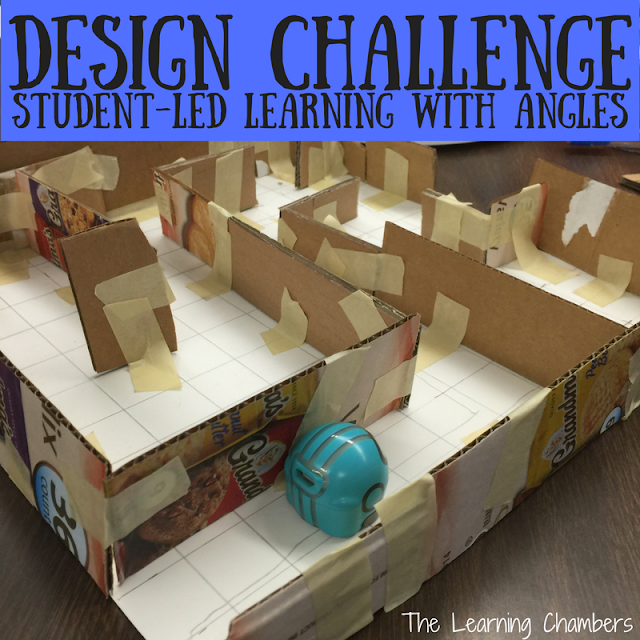
One of my favorite student-led learning opportunities is the design challenge. The only supplies that I gave my students were cardboard pieces, masking tape and poster board (11x11). I learned the hard way that the best thing is to cut the cardboard into strips. The students were able to cut the strips into smaller pieces for their maze. If you give them a box to cut, it will be a disaster. Just warning you now!


My students worked with measurement during this design challenge. They used rulers to make one inch marks to draw out a design grid. They also used protractors to measure angles. They also really got a chance to use critical thinking because we had to make sure that we designed a path that was wide enough to fit our ozobots.


After the design challenge, we worked on programming our ozobots to travel through our mazes. It was a great way to make our design challenge relevant.

I hope that you are able to implement student-led learning in your classroom. I would love to hear about your experiences.

Word Study in an Upper Elementary STEM Class {w/ iTeachSTEM}

What does word study look like in an upper elementary science classroom? Content vocabulary and root words. Breaking down words and making connections through visuals and common experiences enables students to better understand the meaning of complex science words.

VISUAL VOCABULARY CARDS:
At the beginning of each unit, I hang a set of related "visual vocabulary cards" on my cabinets. This gives students a reference for the most important terms to be used in the upcoming weeks. What I love about these cards is that each one has a picture to help students make a connection. (This is especially helpful for my SPED and ELL students.)
What does word study look like in an upper elementary science classroom? Content vocabulary and root words. Breaking down words and making connections through visuals and common experiences enables students to better understand the meaning of complex science words.
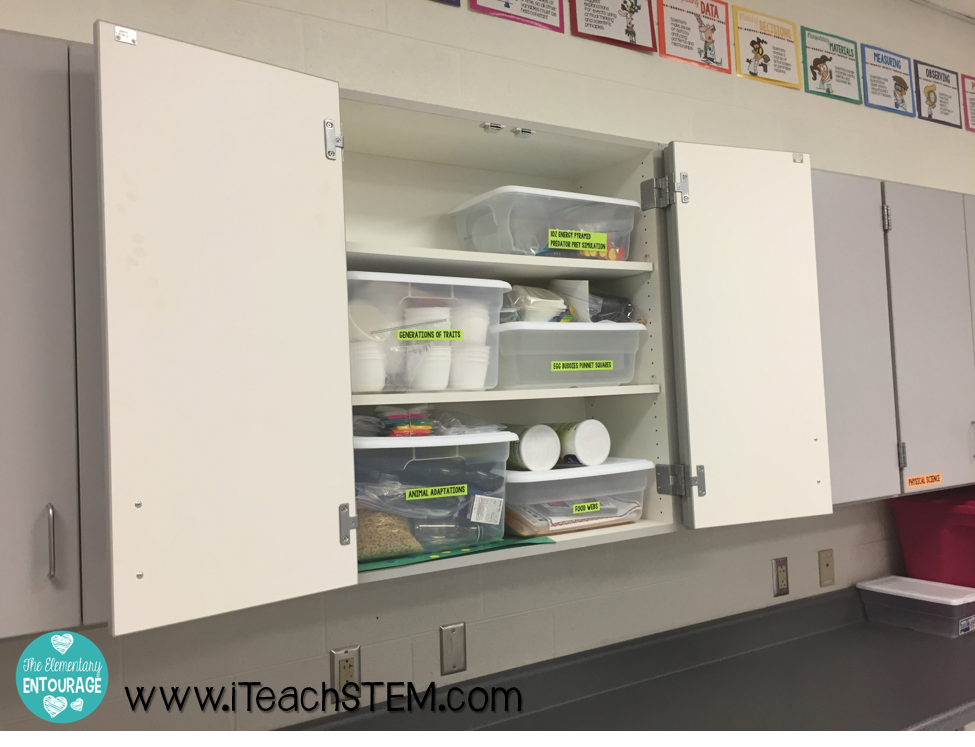
I recently started hanging them on the cabinet doors because it's super easy to hide them in the case of a pop quiz or test. Just open the cabinets!
What does word study look like in an upper elementary science classroom? Content vocabulary and root words. Breaking down words and making connections through visuals and common experiences enables students to better understand the meaning of complex science words.

FOCUSED HIGHLIGHTING:
Another strategy I use when teaching vocabulary is to have students highlight parts of the word and/or definition as they are recording it in their journals. I find that looking at each word and the meaning of its root helps students to better remember the meaning. For example, students struggle to understand what "binomial nomenclature" means, so I have them highlight and note the meaning of each part of the terms. I sometimes have to tweak the meaning to fit better in what we are learning without adding more confusion.
What does word study look like in an upper elementary science classroom? Content vocabulary and root words. Breaking down words and making connections through visuals and common experiences enables students to better understand the meaning of complex science words.
Another unit where I do a lot of highlighting during vocabulary instruction is when teaching students about the types of symbiotic relationships in an ecosystem. For each term, we highlighted a part of the word and then the portion of the definition that showed the meaning of the root or prefix. We also drew silly faces (#emojisareawholelanguagenow) to help students remember the subtle differences in each type of relationship.
What does word study look like in an upper elementary science classroom? Content vocabulary and root words. Breaking down words and making connections through visuals and common experiences enables students to better understand the meaning of complex science words.
Because these terms cause so much confusion for my students each year, I also have them come up with their own "mini-poster" to illustrate the meaning of each word. I love how this student included such well-mannered organisms in his examples. Not only does drawing pictures help students learn and remember the meanings, but they ENJOY it too!
What does word study look like in an upper elementary science classroom? Content vocabulary and root words. Breaking down words and making connections through visuals and common experiences enables students to better understand the meaning of complex science words.

SONGS AND VIDEOS:
Another way I try to help my students when studying new vocabulary terms is through music.
We actually just listened to this song about heat transfer today. My hubby stopped by to bring me lunch and commented that my classroom was "killing music" one cheesy rap song at a time. Hey - the kids loved it and I figure whatever works is worth it!

Now, to be fair, I CANNOT sing well. And my rapping leaves something to be desired. But, YouTube has some really great channels with so many fun songs to help students learn science concepts. I've got a bunch of them saved to this board on Pinterest.

SYMBOLS AND DIAGRAMS:
Sometimes during notetaking I realize that students would benefit from some "silliness" that actually helps them along the way. Last week I was trying to define "heat conductor" in a way that would stick with them. It's so close to the holidays so I started talking about how I love watching the movie The Polar Express. In it there is a train conductor whose job is to get the children from their homes to the North Pole to see Santa as quickly as possible.
What does word study look like in an upper elementary science classroom? Content vocabulary and root words. Breaking down words and making connections through visuals and common experiences enables students to better understand the meaning of complex science words.
I connected this to heat conductors whose job is to move heat more quickly from one object or location to another. After trying to make the connection I started doodling in my journal and drew a train. My students started giggling and whispering "Are we supposed to be drawing that too?" So I wrote the letters H-E-A-T in the train cars to represent heat being transferred quickly from one place to another by a conductor. They laughed and a few of them have even referred to that drawing in later discussions.


Teaching Then and Now {w/ iTeachSTEM}

Here are some tips for moving away from the teacher manual and moving toward more engaging lessons that will not only capture your students' attention but allow you to cater to their learning styles and personal interests.
Times have changed. Even in the eleven years I've been teaching, I've noticed BIG differences in how I plan and teach my lessons. Despite teaching fifth grade all eleven years, I have found that the way I deliver instruction and the way I check for understanding have not only changed but improved!

As I sat down to type this, I started to think back to when I was in high school. I always loved science. It was the class where I was able to talk to my friends, work in groups, and do experiments. I did well in those classes and when I had the opportunity I would sign up for extra science classes. So why was science more interesting? Because I was actually a PART of the learning process. I was engaged in what I was learning. I was applying the content during experiments. I was communicating with my peers.
When I first started teaching, my lessons came directly from the adopted textbook. I taught each lesson in order. I assessed using the provided tests. My lesson planning was super easy, though. I just wrote down the page numbers in the teacher's manual and moved on. But to tell you the truth, I usually spent my lunch and planning times stressed because I was trying to re-read and understand what on earth I was trying to get my students to do that day. Let's be honest. I was in survival mode - trying to teach all subjects every day to a group of fifth grade students who were almost as tall as me!
Here are some tips for moving away from the teacher manual and moving toward more engaging lessons that will not only capture your students' attention but allow you to cater to their learning styles and personal interests.
The problems was, students were rarely excited about my lessons. They listened, mostly. They practiced what I asked. They did homework. And they performed decently on tests. But they were B-O-R-E-D. And so was I! Let's be honest, reading a chapter and answering questions get old pretty quickly. For both students AND their teachers.
Here are some tips for moving away from the teacher manual and moving toward more engaging lessons that will not only capture your students' attention but allow you to cater to their learning styles and personal interests.
My teacher manual sits on a shelf behind my teaching station (nope, I don't even have a desk anymore). I think the last time I grabbed it was to show students a diagram in the book so they wouldn't have to dig for their own textbooks (that they rarely use). I plan each lesson using various resources. I include multiple learning styles and hands-on strategies. I spend time looking for ideas on Pinterest, TeachersPayTeachers, and Google that will enhance the lessons I already have developed. I have been able to take ownership of each lesson that I teach. Which means I am NOT spending my lunch stressing, but EATING (novel idea, I know).
But change wasn't easy. Letting go of a provided curriculum took a leap of faith and (gasp) a lot of work on my end. I needed to be sure that what I was teaching the students helped them to be prepared for those end of the year tests we all love (dripping with sarcasm). But, here's the thing. When students make connections to the content they are more likely to remember what they have learned and be able to apply their knowledge in various situations. It's a win-win situation.

Here are some tips for moving away from the teacher manual and moving toward more engaging lessons that will not only capture your students' attention but allow you to cater to their learning styles and personal interests. 

My first year of teaching I was the ONLY fifth grade teacher at a very small school. While I did my best to ask for help and work with other teachers, I was basically on my own. Not only was it lonely, but it was hard. I didn't really have anyone to bounce ideas off of or ask for input. I'm lucky that now I work with a great team of teachers. However, I am still the ONLY fifth grade STEM teacher. So I've had to get creative with how I collaborate. I have joined several Facebook groups where we can share ideas and resources. I also get together with other STEM teachers in my district on occasion to plan and develop activities.
Let's be honest, some of the PD classes are downright boring. We are just like our kids. If we can't see a direct connection between the content and our lives, we disengage. So choose your professional development activities wisely. Is there a new piece of technology you'd really like to integrate? Look for a class that focuses on that. Do you need a chance to meet with other teachers to develop lessons? See if your administrator will let you spend a half day collaboratively planning. Would watching another teacher help you improve your own lesson delivery? Find someone willing to let you observe them once or twice. Have you come across a great teacher's blog who has ideas that you'd like to incorporate into your own classroom? Read what has been written. Comment or even email the teacher with questions. You'll be surprised at how much you can learn from someone you've never even met in person!
Here are some tips for moving away from the teacher manual and moving toward more engaging lessons that will not only capture your students' attention but allow you to cater to their learning styles and personal interests.
And don't be afraid to share your OWN expertise. I just took a leap out of my comfort zone and led a session on interactive notebooks last summer. Not only was it a great opportunity to share my ideas, but it was amazing how many other approaches were shared that I have begun to integrate into my own classroom.
Good teachers do this automatically. We think about what went well and what didn't work as well as we had hoped. The key is to make changes based on your reflections. Since I'm the only science teacher in my grade level, I often share how things went with my husband. (Poor guy.) I tell him about the day and what I wish I had done differently. Sometimes just saying it out loud - even to a non-teacher like my husband - helps me to come up with ways to improve the activity.


The planning process has actually gotten much quicker for me over the years. Mostly because I take the time to reflect on my lessons and write notes to myself. I keep a journal for each of my classes, and save one from each year to use as a resource the following year.
Here are some tips for moving away from the teacher manual and moving toward more engaging lessons that will not only capture your students' attention but allow you to cater to their learning styles and personal interests.
When I am reflecting on each activity or unit, I jot notes to myself on Post-its and stick them right in the journal. That way when I open up to the pages, I am reminded of what I wanted to change and how I could improve the lesson. It's almost like a teaching diary!
Don't get me wrong. This is not easy. In eleven years of teaching, I still get bogged down and want to give up - at least once a week if not more. But then I remind myself that my students are learning and that the process is just as important as the end result. I also spend a lot of time in my teaching partner's room venting and bouncing ideas off of her. She's great for that!

Tricks & Treats from The Learning Chambers


Halloween is just around the corner and that means it's time again for EE's Tricks and Treats.  The Elementary Entourage bloggers will be sharing some of their favorite teaching tricks and tips.  We will also have some terrific teaching treats just for our readers!  Make sure you stop by each day for some trick or treating fun!

I am very excited to share some teaching tricks to help you implement an ozobot challenge into your classroom.  I love STEM challenges that involve programming and the ozobots have definitely been a class favorite lately.  Here are some tips and tricks to help you implement a challenge that uses both quadrants and coordinates.


My first trick is to make sure that you give your students time to explore.  It will really help with classroom management and will also give your students time to work through challenges and learn how to use the ozobots independently.


My second trick is to align your ozobot challenge to something that your students are currently learning about.  My students were learning about x and y coordinates and the four quadrants, so our ozobot challenge centered around that.


After our lesson, I gave the students a piece of grid paper and a checklist.  The students had to find the point of origin and then label the x and y coordinates.  As part of the challenge, they had to determine the starting part or where their ozobot would start.  Then we used ozoblockly to program our ozobot to complete "tricks" inside of the grid.  The challenge was to make sure that our ozobot stayed inside the grid.  It was a challenge but a fun one!

Do you want to have your students complete this ozobot challenge using quadrants and coordinates?  I have this freebie as a treat just for you!  I included several different grid paper sizes for easy differentiation and also an easy to follow checklist.  I hope this helps you implement the coordinates challenge into your classroom.


Click HERE to grab your treat!

Sensational Science {with iTeachSTEM}

Quick review...
iTeachSTEM.
Like, every day, every class.
STEM.
So could this topic be any more perfect for me to blog about?!?
Students complete different interactive notebook templates and review sheets to help further solidify their understanding of each organelle of a cell and it's role in the plant and/or animal cell.
Absolutely!
And you'd think I would find it easy, right?
But noooooooo.
Leave it to me to struggle trying to narrow down what I actually want to share with you wonderful readers.

I've been brainstorming ideas for weeks now to no avail. My solution? The other day I asked my students to write an informal essay telling me what their two favorite units from fifth grade science were and WHY they liked them so much. #worksmarternotharder

The top three units were...
It's a whole lot easier to make a choice when it's narrowed down to THREE instead of "everything I've ever taught in science"...

So today I share some of the fun ways I teach about plant and animal cells.
Honestly, it's one of the first units I teach each year and I really DO love it.
Students complete different interactive notebook templates and review sheets to help further solidify their understanding of each organelle of a cell and it's role in the plant and/or animal cell.

Here's the catch, though...
My fifth graders have already LEARNED about cells in fourth grade. The only difference is that in fifth grade we add in the mitochondria to the list of organelles. I hate to literally repeat what students have done in the past, so I try to find creative ways to review what they (should) already know from FOURTH grade before "digging deeper" into the cell and what they should know in FIFTH grade.

I like to start my unit on cells by asking students to classify cells as either plant or animal cells based on the structure of each cell. In fifth grade, that means understanding that a plant cell has three specific differences from animal cells.

1. A plant cell has a cell wall that provides structure and added protection to the cell.
2. A plant cell has chloroplasts filled with chlorophyll where energy from the sun is used to create food for the cell through photosynthesis.
3. A plant cell usually has 1-2 larger central vacuoles rather than many smaller ones as in animal cells.
Usually after a think-pair-share, we are able to complete the notebook pages shown below (with a little guidance from me).
Students complete different interactive notebook templates and review sheets to help further solidify their understanding of each organelle of a cell and it's role in the plant and/or animal cell.

My students have a great time acting like Crime Scene Investigators as they try to determine which cells found at the location of an imaginary burglary are plant cells and which are animal cells. My favorite part of the CSI Challenge is that students are given actual images of plant and animal cells to work with. I have found that more often than not, students have the misconception that a plant cell is rectangular and an animal cell is a circle. They fail to look at the specific organelles. Also, most students have only had experience with drawings and/or diagrams of cells, so seeing actual images taken by an electron microscope forces them to apply their understanding in a different situation.
Students complete different interactive notebook templates and review sheets to help further solidify their understanding of each organelle of a cell and it's role in the plant and/or animal cell.

Another favorite activity for my students is "Let's Take a CELL-fie!" Come on, it's cheesy, but it's funny too! Students liked this activity because they got to work in groups to use a really cool app called "ThingLink" to create an interactive image. I liked this activity because students actually start to remember the functions of each organelle since they must select objects from home that have a similar "job" to be used in their group's "Super Cell". Here is one of the better examples of "CELL-fies" from this year.
Students complete different interactive notebook templates and review sheets to help further solidify their understanding of each organelle of a cell and it's role in the plant and/or animal cell.
If you'd like to read more about creating interactive images using ThingLink, check out this post.


I like to use lots of analogies and ask my students to do the same. I also display visual vocabulary posters on my word wall so students can reference them as needed. Each poster includes an analogy that compares the organelle's function to an other "real life" job.
Students complete different interactive notebook templates and review sheets to help further solidify their understanding of each organelle of a cell and it's role in the plant and/or animal cell.

Throughout the unit, I have students complete different interactive notebook templates and review sheets to help further solidify their understanding of each organelle of a cell and it's role in the plant and/or animal cell. I love this activity where students imagine what each cell organelle would say if it could actually talk. Students were super creative and quite accurate for the most part. Here are a couple examples of student work.
Students complete different interactive notebook templates and review sheets to help further solidify their understanding of each organelle of a cell and it's role in the plant and/or animal cell.
I love the bossy nucleus in this one: "Hey! Mitochondria! Scoot over! I control the cell! Don't do that!"
Students complete different interactive notebook templates and review sheets to help further solidify their understanding of each organelle of a cell and it's role in the plant and/or animal cell.
My favorite from this one is the cell membrane: "Party's full, dude!" since the membrane regulates what enters and exits the cell.

Students complete different interactive notebook templates and review sheets to help further solidify their understanding of each organelle of a cell and it's role in the plant and/or animal cell.
The activities from above (and a whole lot more) are included in my Cells Bundled Kit. If you'd like to take a closer look at what's included, check it out HERE.

I hate to disappoint anyone who might have been hoping that I'd share how I teach the solar system or states of matter, so here is a link to some of my favorite resources as well as the Pinterest boards where I store even more great ideas for these units!

https://www.pinterest.com/iTeachSTEM2kids/stem-states-of-matter/https://www.pinterest.com/iTeachSTEM2kids/stem-cells-photosynthesis/https://www.teacherspayteachers.com/Store/Iteachstem/Category/STEM-Solar-System-235840

I hope you found some of the ideas here inspiring, because when a teacher is excited and motivated to teach science the students also look forward to learning more about science concepts.