Facebook Pinterest Instagram Bloglovin' Teachers Pay Teachers Image Map

Engaging Games to Get Your Students Moving While Learning

Now more than ever, it's important to include some movement into learning. With schools limiting recess, free play, and even special area classes like PE, music, art, etc. This is one reason I developed my Fluency & Fitness resources a few years ago. I wanted to make learning more fun again! 
Fluency & Fitness allows students to work on essential reading and literacy skills, but then get a chance to move and exercise every few slides. Here's a sneak peek of some Fluency & Fitness in action in the classroom. 
These games can be used during your reading or math block, transitions, brain breaks, morning meeting, inside recess, etc. They only take about 2-3 minutes to play and are very helpful to give your students a fun way to review. Below is a preview from my Silent E Fluency & Fitness Bundle. This particular game has students turn CVC words into CVCe words. 
Students BEG to do these and don't even realize how much they're learning. Teachers love that not only are their kids having fun, but they don't have to lose any instructional time. This is the Money Fluency & Fitness Bundle.
I left these games so you can adapt them for your own classroom. You can choose to click through the slides manually or add a timer if you'd like to participate with your students. :) I like to click through so I can go slow as we are still practicing the skill, then a lot faster as they've mastered it. This Number Sense Fluency & Fitness is one my best sellers. You can find more Fluency & Fitness games here, including grade level bundles and my popular MEGA bundle!
Since teachers are loving Fluency & Fitness, I wanted to create something similar but with a team or small group aspect and Holiday themes. My new resources called Fluency Find It have students work in small groups. Students look at the screen and then find the answer on a worksheet at their table. They may find the matching letter, middle vowel sound, answer to the math problem, etc. That student continues playing until they see the "switch spots" slides, and then they go to the end of the line. Students may help each other with the answers if their friend needs help. I've played these games since October and really love watching how the students work together.
Each Holiday comes with 5 games that students should be fluent in for that time of the year. Here's a peek of the 1st grade St. Patrick's Day Fluency Find It in action. I have these games for Kindergarten and 1st grade, but will be working on the 2nd and 3rd grade sets soon. You can find all of my Fluency Find It game here

Ideas to Get Your Kids Moving


How do you get your kids moving in your classroom besides GoNoodle and all the other normal brain breaks? Do you try to incorporate moving while they are working? Well, one thing that I've implemented with my kids is a timed Stretch break multiple times during our day. It lasts ONE minute and literally helps to get them up and then back to work. It doesn't matter what we're doing, but they stop and stretch. How does it work? Here's how:

During our Daily 5/Small Group time, I have it on a PowerPoint. It is timed to keep me on schedule. If not, I'll take too much time and usually end up missing a group. I try to see all of my kids every single day and the timed PowerPoint keeps me on track. Well, our rotations are usually about 20 minutes each. For some of my kids, that is WAY too long. Their brain needs a break. Without leaving where they are, the PowerPoint changes slides after 10 minutes. It shows the "STRETCH" slide. I have a sound set when it changes so everyone knows to look at the Smartboard. The sound is a little ding when it's time for a stretch. I have it set to YEE-HAW when it's time to switch places.


GAME CHANGER. This is an up-close of their rotation. This is one of the days I needed to pull kids individually so no one came to me as a group.


My kids use that one little minute to quietly stand up and stretch. During our calendar time, they've learned a ton of body stretches. This has come in handy because they have a lot of stretches that they can do within this quick minute. Our favorite is the neck roll which they named "Bobble Head" this year. We roll our neck around and then switch and do the other side. They do this on their own. I honestly have zero research about this, but my kids are SO focused with just this super tiny break inserted.

Here's what our stretch slide looks like up close. Nothing special. It could even just say the word stretch to signal that it's time for a break.


We only add in a stretch every other rotation. The results are amazing! Try it with a chime or some time of signal and watch how it works. That's how we get in a little bit of moving without actually leaving our Daily 5/center area. It's quick, quiet, and gives them back the needed focus on their task.


It's SUPER easy to do on your own. Just have your powerpoint rotations up and click on transitions. You can set how long you want each of the slides to be. I duplicated the rotation slide since they were going back to the same thing after their stretch time.


Unclick the 'On Mouse Click' and make sure there is a check in the 'After' box. Then, set your time. That's it!


Get Moving with Scavenger Hunts

How much recess time do you get in your day? I think most of us would agree that our kids need to move more.  Unfortunately we don't always have a say or control over adding more recess time, so my solution has always been to add active learning whenever possible.

 Here in Wisconsin the winter can seem never ending so I need to find ways to get moving that don't always involve going outside.  One way I have incorporated more indoor movement is with the use of academic scavenger hunts. These can definitely be done indoors or out, and in homeschool or the classroom. This morning was snowy and wet so we chose to stay inside. Here's how it works:

First, print themed cards with the numbers 1-10.

Next, hide them all over the house or classroom.

Then give each child a clipboard, recording sheet and some crayons and send them off to find the first card. You can choose to have kids search for them in numerical order or in whatever order they find them first.

We are working on number recognition, so after finding a card my Madelynn would tell me the number, then color it on her paper. In a large classroom, students may tell you the number or just find it on the paper whatever is manageable for you.

To spice things up I gave Madelynn a different action to do as she searched for her next card. My favorites? Fly like a bird, crawl like a turtle, gallop like a horse, run like a cheetah, slither like a snake, walk like a bear, tiptoe like a ballerina, and hop like a rabbit. This definitely helped to get a little extra energy out and prevented her from just slowly walking to each new card.

I created different levels of response sheets to practice counting sets and writing numbers as well. If you'd like a copy you can grab them here:

This seed themed alphabet scavenger hunt is also included FREE with 3 leveled response sheets for uppercase letter ID, upper/lower case match, and letter writing.

I hope you enjoy them as much as we do!


Persuasive Writing Tips (with The Friendly Teacher)


Hello! It's Hannah from The Friendly Teacher here! Whenever we do writing we always start with a mentor text. Why? Because I want to always connect my writing with my reading. I think that it is important for students to know that the two are completely combined. I also think reading a mentor text first helps the students to have a model to understand what they are to write.

So, before I ever begin a writing I always start with reading a story that is written in that type of writing. When we do this we JUST READ! We don't focus on a skill, all we focus on is reading and listening to how the author writes.

Then, after we read we start the writing process using a prompt that is related to the book that we just read.

My favorite type of writing to use mentor texts with is Persuasive Writing! I love using it with persuasive writing because the books are so darn fun!!

Here are ten great books for persuasive writing with the writing ideas! There are also two free units for you to give this a try!

1. I Wanna Iguana by Karen Kauffman-If you sign up for my newsletter here you get a great packet to go with this book for FREE 

2. Click, Clack, Moo Cows that Type by Doreen Cronin- This is great for persuasive letter writing.  We love to write letters to Farmer Brown like we were farm animals. Check out the unit here! 

3. Dear Mrs. LaRue by Mark Teague-Another one for great letter writing! Grab the whole unit for FREE here!

4. The Day the Crayons Quit by Drew Daywalt-Hilairous letters will come out of this book! The students write in the eyes of a crayon and it is so much fun! Check out the unit here! 

5. The True Story of the Three Little Pigs by Jon Scieszka- Have your students write trying to talk the wolf out of blowing their house down! The students will get a kick out of it!

6. I will Never Not Ever Eat a Tomato by Lauren Child- This is a healthy food lesson and a persuasive lesson! Get those two birds with one stone! Have the students write persuasive pieces on what they would not eat!

7. Can I Have a Tryannosuarius Rex Dad! Can I Please? by Lois G. Grambling- Dinosaur units are my favorite! My kids get so into them! Mix your dinosaur unit with this great persuasive book! Have the students write a letter to their parents explaining why they should get a pet.

8. I Wanna New Room by Karen Kauffman- Writing letters to parents is always a funny way to mix curriculum with parent involvement! You can have them write a letter to their parents about something that they want!

9. My Teacher for President by Kay Winters- This is a fantastic way to mix government lessons with persuasive writing! You can have your kids write why you should be president or they could choose another person to be president. And you could see why your students love you so much. Who does not like that?!?! 

10. LaRue for Mayor by Mark Teague- With this book you can have the kids write a persuasive speech on why someone should be in government! Hello, your are getting all kinds of content in there!

I hope you can use some of these ideas in your class!!!


How to Writing Tips and Tricks {Teach Two Reach}


Writing CAN be fun! Teaching informative, persuasive, narrative, etc. types of writing to kids can lead you to some of your most interactive and tangible lessons. 

One way that I create excitement for kiddos to go through the whole writing process is through food. I know some schools do not allow the use of food, but you can come up with other fun objects that kids will get intrigued with...such as Target dollar spot erasers.

I am going to go through two ways that I introduce "How To," and sequence writing. 

One way is through a project called "How to Make a Peanut Butter and Jelly Sandwich." 
Now, I can give them graphic organizers, templates, etc, and just tell them to write out of memory. But WHAT IF I showed them what their writing actually translates to in real life?
I recently saw a video on FB of a dad doing this with his kids' writing. It was hilarious and it taught them that what they were writing isn't exactly what they meant.

I recently did this with some kids that I tutor at home. I had them initially write out their First, Next, Then, and Last steps and I told them that I will follow exactly what they wrote. And it didn't disappoint!


When the kids brought up their writing to me the first time, the result was hilarious. They wrote things like rub the peanut butter on the sandwich, without telling me how..so I took the whole bottle and rubbed it on the sandwich. They said things like put the jelly on the bread with the knife, but didn't specify where, so I put it on the edge. They wrote at the end to put the two pieces of bread together, but didn't tell me in what direction, so I stacked an edge on top of the face of the other bread. They thought it was hilarious. They had to go back at least three or four times and I kept on trying each of their revisions, until they got it just right. They added a lot of details by the end and it showed them how important it is to be very specific. These kids wrote out it out on notebook paper, but I also have used my writing pack for this assignment in the classroom. At the end, they get to create a faux peanut butter jelly sandwich booklet to write the final copy of their steps. You can check that out here. 


I also do this same type of activity with blowing a bubble with bubble gum. First, I demonstrate how to blow a bubble, talking my way through exactly what I do, showing them what is happening to the gum at each step. Then I let them try it and work with them through the steps. Many of them actually learn how to blow one as well if they didn't know before. After some practicing, then they write out the sequence steps. After the graphic organizer, rough draft, and final copy, we do a great bulletin board display by using a pink balloon to represent the bubble. Everyone loves to pass by this project in the hallways! You can find it here. 


Crafts, food, projects, are a surefire way to get kids happy about writing!
Thanks for stopping by...:)


Writing Tips in PreK and a Freebie {ALL Y'all Need}


I absolutely LOVE teaching writing in PreK because the growth is incredible! Throughout the year, I witness students from drawing lines to represent words to sounding out and blending words by the end of the year. Here are my five essential tools for successful writing in PreK:

#1 Mat Man
Our school uses Handwriting without Tears to introduce letter formation. My favorite part of the program has to be Mat Man. Not only does Mat Man teach them how to draw people, it also teaches them how to form straight and curvy lines that are used in letter formation.

#2 Play Planning
At my school, students write about where they are going for center time every day. They start out by drawing a picture of what they are going to do at the center and tracing the sentence, "I am going to the ____ center." By the end of the year, they are writing the sentence independently and extending the sentence. For example: "I am going to the blocks center to build a road."

#3 Writing Center
Create a writing center where the students can free write in a journal. In my writing center, I have markers, tape, crayons, word cards, and different types of writing paper for them to use. This past week, my students have been creating their very own Valentine cards.

#4 Write on the floor
Give your students a clipboard and let them write while laying on their tummies! Research shows that students are more prone to develop correct pencil grip and muscle memory if you allow them to write on the floor.

#5 Create Books
Over the past few weeks, my students have been creating their "Love Book." I just took some blank books from the Target Dollar spot and added pages that pertain to our theme. The kids LOVE how personalized the books are! Here are a few pictures of our "Love Books."


Freebie! 
Click on the link below to get your copy of the "Love Book." It is specifically measured to fit blank books from The Target Dollar Spot. 
https://drive.google.com/file/d/0B6XMrIPIox8IZ1dhMzVta3VQVDA/view?usp=sharing

Happy Teaching!

5 Easy Steps for Motivating Reluctant Writers

Writing is not my forte. I know, I know, I'm a blogger I should love writing, right? But I have always dreaded putting pencil to paper to get my ideas out. Things always sound great in my head but never seem to come out right.  Although I muster up all the enthusiasm in the world for my students, I just know that many of them feel the same way every time I flip the schedule card to Writing Workshop.  So how do I reach these little sweeties that just aren't motivated to make progress in writing? I'll show you in 5 easy steps.
If you teach kindergarten and maybe even first grade, eek, you are no stranger to a page full of random scribbles.  You may be pulling your hair out wondering how on Earth you are ever going to get this kid to some level of proficiency by the end of the year, trust me, I've been there.  Here are my 5 easy steps to push those kiddos to find their inner author.
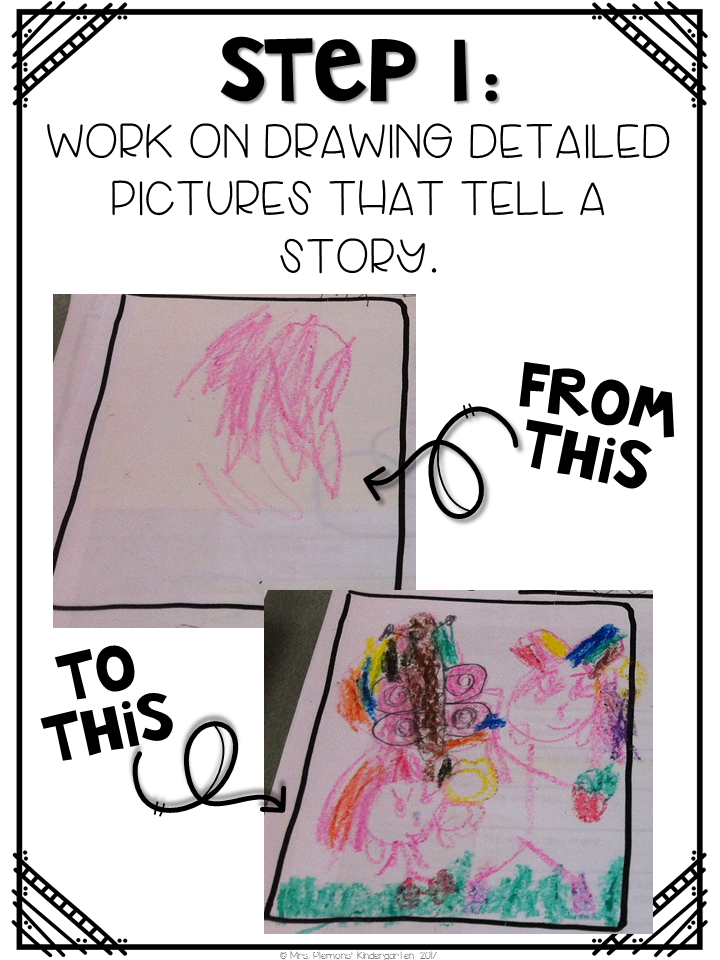
 Yup that's right, step one has nothing to do with actually writing words...(yet!) Because seriously, "tell me about your picture" only works if there is something to actually talk about.  That's why before ever pushing students to write words I focus a TON on adding detail to the picture.  I stress that someone should be able to look at their picture and know mostly what is happening. They should never have to guess who are those people, where are they, and what are they doing. Of course during this time I ask them to dictate their story afterwards while I write.  They watch as I write the words slowly, modeling (painfully slow...) how I sound of the words and write each one.  I also make sure students are working on letter sounds throughout the day so that they have these skills down when they are ready to try writing.
 Now that their pictures are so full of detail and popping with excitement, I encourage students to label at least a few parts. Maybe they label the characters one day, the setting the next, you get the idea. Sometimes students jump right in to adding many consonant sounds for their words, while other sweet little friends need more structure. If they are still reluctant I start by asking them to at least write the first sound they hear in each word. Then we move on to beginning and ending, then all consonants, then vowel sounds (maybe...)
 Next up, patterned language books! Anyone who's read Brown Bear, Brown Bear aloud 1,867 times knows the power in repeated language.  Well repeated language is so helpful in writing as well. It really builds student confidence and gives them a chance to try out their growing sight word vocabulary. I usually write the first part of the sentence on a card or white board for students to reference while making their book and their job is to write it on each page and add a word or words to complete the sentence. I try to switch up the sight words often so they see how much they know and can try out on their own when they are ready.
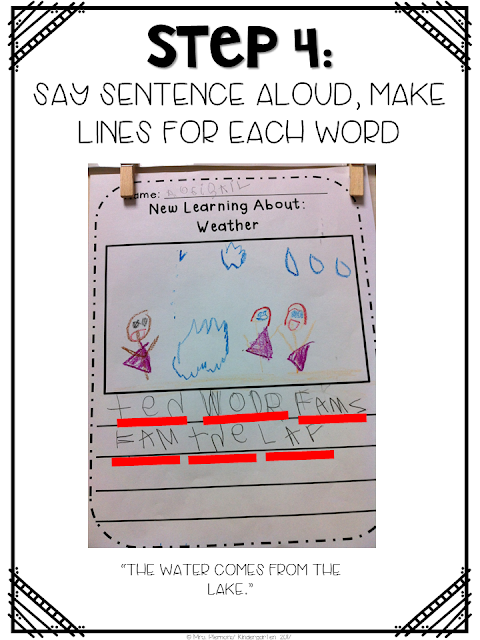
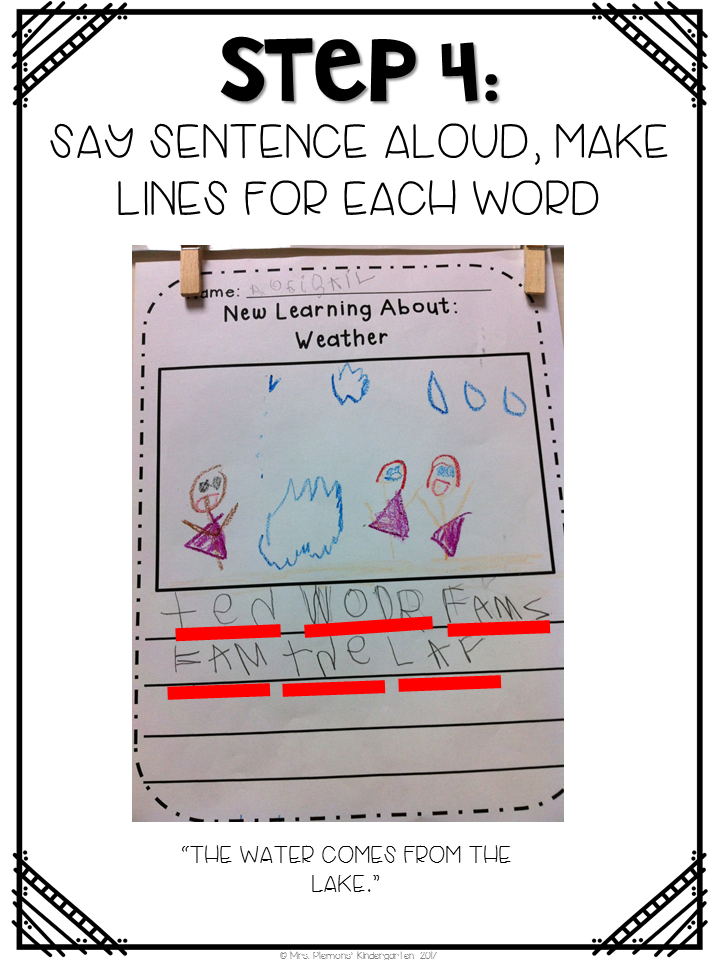
 Here's the big jump into independent writing. I start with students telling me one sentence about their picture. I draw a line for each word and they must write something for each word on each line. Our mini goals again start out with just writing beginning sounds, then beginning & ending, then all consonants, and finally trying out vowel sounds. To move students towards independence with this I have them begin to help me count how many words are in their sentence, then they draw their own lines, then slowly they realize they don't need the lines at all.
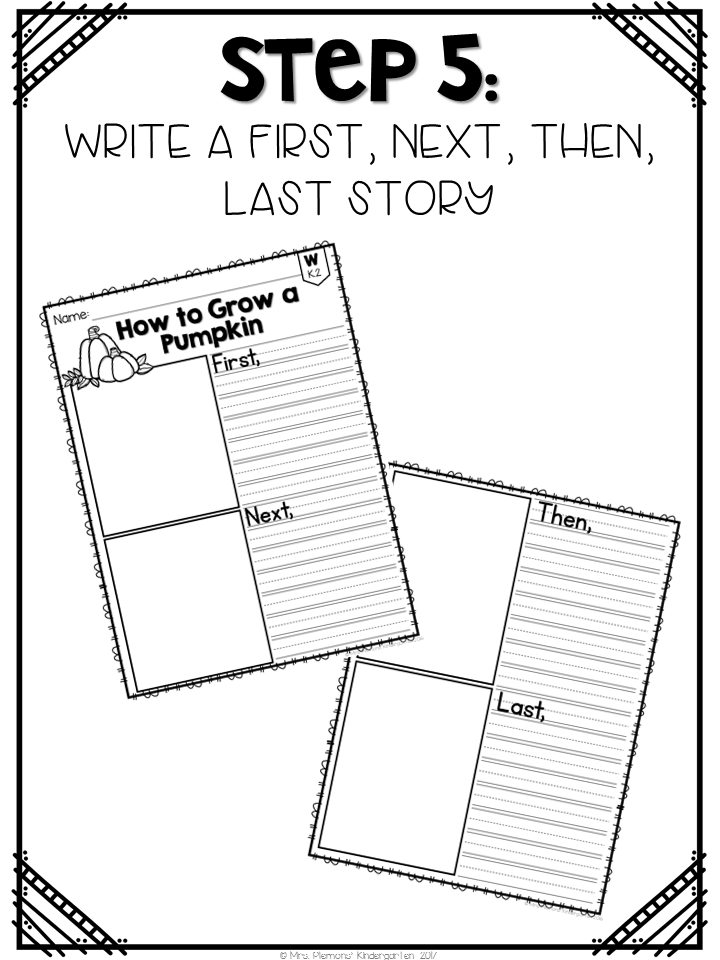
So finally when my reluctant writers are writing, but still not going beyond 1-2 sentences, I break out the first, next, then, last stories. I have a million prompts for these, but I also try to leave it open ended and tell students to write about something that happened. 

Writing is such a huge process for the youngest students when you think about all the skills they are combining. I hope trying out some of these steps will help you see progress in your most stubborn challenging little writers!